Maids and Mandrakes: Dysfunction, Departure, and Divine Grace in Genesis 30
Exploring the Messy Realities of Jacob’s Family and God’s Unfailing Plan
Passages like Genesis 30:1-24 are the kind that make pastors hesitate when preaching through entire books of the Bible. It’s a raw, unflinching look at family disintegration—a breeding war fueled by jealousy, superstition, and conflict. Think of it as an ancient blend of Dallas (with its scheming oil tycoons) and Sister Wives, but set in the Old Testament. Yet, if we skip over these uncomfortable chapters, we miss profound opportunities: to confront pressing cultural challenges and to witness how God’s remarkable grace can redeem even the most broken family situations.
In this post, we’ll dive deep into the story, unpacking its historical context, theological insights, and practical applications. We’ll see how human folly clashes with divine design, and how grace ultimately triumphs. Whether you’re wrestling with family dynamics, cultural debates on marriage, or simply seeking encouragement in your faith journey, there’s wisdom here from the patriarchs that speaks directly to our modern world.
In this post, we’ll dive deep into the story, unpacking its historical context, theological insights, and practical applications. We’ll see how human folly clashes with divine design, and how grace ultimately triumphs. Whether you’re wrestling with family dynamics, cultural debates on marriage, or simply seeking encouragement in your faith journey, there’s wisdom here from the patriarchs that speaks directly to our modern world.
Setting the Stage: Deception, Marriage, and Early Blessings
To understand Genesis 30, we need a quick recap from the previous chapter. Jacob, fleeing from his brother Esau after stealing his birthright and blessing, ends up working for his uncle Laban. Jacob falls in love with Laban’s daughter Rachel and agrees to serve seven years for her hand in marriage. But Laban tricks him, substituting the older sister Leah on the wedding night. Jacob, undeterred (or perhaps resigned), works another seven years to marry Rachel as well. This polygamous setup—born of deception—sets the stage for the drama ahead.
God, seeing Leah’s unloved status, blesses her with fertility. She bears Jacob four sons: Reuben, Simeon, Levi, and Judah. These names aren’t random; they reflect Leah’s emotional turmoil and gratitude to God. Reuben means “See, a son,” expressing her hope for Jacob’s affection. Simeon (”Heard”) acknowledges God’s attentiveness to her pain. Levi (”Attached”) longs for marital unity, and Judah (”Praise”) shifts to worship despite the hardship.
Rachel, meanwhile, remains barren—a devastating reality in a culture where children, especially sons, were essential for security, inheritance, and legacy. This infertility ignites the envy and rivalry that drives the chapter.
God, seeing Leah’s unloved status, blesses her with fertility. She bears Jacob four sons: Reuben, Simeon, Levi, and Judah. These names aren’t random; they reflect Leah’s emotional turmoil and gratitude to God. Reuben means “See, a son,” expressing her hope for Jacob’s affection. Simeon (”Heard”) acknowledges God’s attentiveness to her pain. Levi (”Attached”) longs for marital unity, and Judah (”Praise”) shifts to worship despite the hardship.
Rachel, meanwhile, remains barren—a devastating reality in a culture where children, especially sons, were essential for security, inheritance, and legacy. This infertility ignites the envy and rivalry that drives the chapter.
The Text: A Play-by-Play of Rivalry and Resourcefulness
Let’s walk through Genesis 30:1-24 (ESV) with commentary, as if we’re courtside at a chaotic family feud.
Rachel, desperate and envious, confronts Jacob: “Give me children, or I shall die!” (v. 1). Jacob snaps back in anger: “Am I in the place of God, who has withheld from you the fruit of the womb?” (v. 2). Here, we see a key lesson: Not every hardship has a human culprit. Circumstances aren’t always “someone’s fault”—sometimes they’re just the broken reality of life “east of Eden,” post-Fall. As leadership guru John Maxwell wisely noted, “Everything rises and falls on leadership,” but not everything. Blame-shifting ignores the myriad factors at play, from providence to personal agency.
Jacob’s response, however, errs in another direction. He assumes God is actively withholding children from Rachel, but the text never says that— it simply states her barrenness. This highlights a common theological pitfall: assuming God’s blessing on one implies cursing on another. We must stick to what Scripture reveals, no more, no less.
Rachel’s solution? Surrogacy via her servant Bilhah: “Here is my servant Bilhah; go in to her, so that she may give birth on my behalf” (v. 3). Bilhah bears Dan (”Judged,” as Rachel feels vindicated) and Naphtali (”Wrestlings,” celebrating her “victory” over Leah). Now Jacob has six sons, but the “win” is illusory—it’s a fantasy misaligned with God’s design, and misery looms.
Leah, not to be outdone, counters with her servant Zilpah, who bears Gad (”Good Fortune”) and Asher (”Happy”). The score? Team Leah: 6 sons (Reuben, Simeon, Levi, Judah, Gad, Asher). Team Rachel: 2 (Dan, Naphtali). It’s like a bizarre sports commentary: “Out of nowhere, the rookie Zilpah scores again!”
The drama escalates when Reuben finds mandrakes during the wheat harvest—plants superstitiously believed to aid fertility due to their root’s humanoid shape.
Rachel, desperate and envious, confronts Jacob: “Give me children, or I shall die!” (v. 1). Jacob snaps back in anger: “Am I in the place of God, who has withheld from you the fruit of the womb?” (v. 2). Here, we see a key lesson: Not every hardship has a human culprit. Circumstances aren’t always “someone’s fault”—sometimes they’re just the broken reality of life “east of Eden,” post-Fall. As leadership guru John Maxwell wisely noted, “Everything rises and falls on leadership,” but not everything. Blame-shifting ignores the myriad factors at play, from providence to personal agency.
Jacob’s response, however, errs in another direction. He assumes God is actively withholding children from Rachel, but the text never says that— it simply states her barrenness. This highlights a common theological pitfall: assuming God’s blessing on one implies cursing on another. We must stick to what Scripture reveals, no more, no less.
Rachel’s solution? Surrogacy via her servant Bilhah: “Here is my servant Bilhah; go in to her, so that she may give birth on my behalf” (v. 3). Bilhah bears Dan (”Judged,” as Rachel feels vindicated) and Naphtali (”Wrestlings,” celebrating her “victory” over Leah). Now Jacob has six sons, but the “win” is illusory—it’s a fantasy misaligned with God’s design, and misery looms.
Leah, not to be outdone, counters with her servant Zilpah, who bears Gad (”Good Fortune”) and Asher (”Happy”). The score? Team Leah: 6 sons (Reuben, Simeon, Levi, Judah, Gad, Asher). Team Rachel: 2 (Dan, Naphtali). It’s like a bizarre sports commentary: “Out of nowhere, the rookie Zilpah scores again!”
The drama escalates when Reuben finds mandrakes during the wheat harvest—plants superstitiously believed to aid fertility due to their root’s humanoid shape.
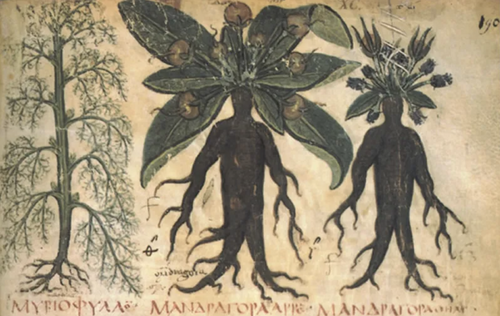
fs.usda.gov
Solanaceae: Mandrake
(The mandrake root, resembling a little person, fueled ancient myths about its aphrodisiac and fertility-boosting powers.)
Rachel begs Leah for some: “Please give me some of your son’s mandrakes” (v. 14). Leah retorts, “Is it a small matter that you have taken away my husband?” (v. 15). They barter: Rachel trades a night with Jacob for the mandrakes. Leah conceives Issachar (”Wages,” rewarding her “hire” of Jacob) and Zebulun (”Honor,” hoping for respect). Then comes daughter Dinah (foreshadowing future tragedy).
Finally, “God remembered Rachel” (v. 22), opening her womb for Joseph (”May He Add”). Later, she’ll bear Benjamin but die in childbirth, completing the 12 tribes.
This isn’t a fairy tale—it’s a mess of manipulation, bartering intimacy, and superstition. Yet, it’s the family God uses to build Israel.
Solanaceae: Mandrake
(The mandrake root, resembling a little person, fueled ancient myths about its aphrodisiac and fertility-boosting powers.)
Rachel begs Leah for some: “Please give me some of your son’s mandrakes” (v. 14). Leah retorts, “Is it a small matter that you have taken away my husband?” (v. 15). They barter: Rachel trades a night with Jacob for the mandrakes. Leah conceives Issachar (”Wages,” rewarding her “hire” of Jacob) and Zebulun (”Honor,” hoping for respect). Then comes daughter Dinah (foreshadowing future tragedy).
Finally, “God remembered Rachel” (v. 22), opening her womb for Joseph (”May He Add”). Later, she’ll bear Benjamin but die in childbirth, completing the 12 tribes.
This isn’t a fairy tale—it’s a mess of manipulation, bartering intimacy, and superstition. Yet, it’s the family God uses to build Israel.
1. God’s Design for the Family: Back to Basics
When chaos reigns, return to fundamentals. Genesis 2 lays out the blueprint: “It is not good that the man should be alone; I will make him a helper fit for him” (v. 18).
Sin disrupts this with Satan’s lie: “God’s way is boring—mine’s better.” Here, Jacob’s household believes they must “help” God fulfill His promises, echoing Sarah’s impatience with Hagar. As 19th-century commentator Robert Candlish observed, who are these “poor worms of the dust” to plot and scheme for God’s purposes? The Lord, who raised children for Abraham from stones if needed, doesn’t require our indecent haste or rivalries.
In matters of marriage and family, trust God’s timing. Medical interventions like ethical fertility treatments aren’t inherently wrong, but they should follow clear divine guidance, not desperation.
- One Man, One Woman: Monogamy as the foundation.
- Husband Leads, Wife Helps: Complementary roles in unity.
- Be Fruitful and Multiply: Children as a blessing, not a competition.
- Subdue the Earth: Growing in dominion together.
- Replicate the Model: Each generation echoes this pattern.
Sin disrupts this with Satan’s lie: “God’s way is boring—mine’s better.” Here, Jacob’s household believes they must “help” God fulfill His promises, echoing Sarah’s impatience with Hagar. As 19th-century commentator Robert Candlish observed, who are these “poor worms of the dust” to plot and scheme for God’s purposes? The Lord, who raised children for Abraham from stones if needed, doesn’t require our indecent haste or rivalries.
In matters of marriage and family, trust God’s timing. Medical interventions like ethical fertility treatments aren’t inherently wrong, but they should follow clear divine guidance, not desperation.
2. Man’s Disastrous Departure: The Polygamy Spectrum
Genesis 30 exemplifies humanity’s deviations from God’s plan, with polygamy at the forefront. It’s not prescribed in Scripture—only described, and always disastrously: rivalry, abuse, favoritism, multi-generational damage.
Yet, polygamy persists in religious and secular contexts.
Religious Arguments:
Bible readers might point to patriarchal examples, but these are cautionary tales, not endorsements. As one humorous illustration goes: A man treating the Bible like a fortune cookie points to “Judas... hanged himself” and “Go and do likewise.” Context matters—Scripture edifies, not emulates every action.
Modern departures include:
These traps promise freedom but deliver bondage. If you’ve strayed, know this: Jesus came to restore, not condemn. Repentance realigns us with God’s path.
Yet, polygamy persists in religious and secular contexts.
Religious Arguments:
- Mormonism: Founder Joseph Smith had up to 40 wives, including a 14-year-old. Successor Brigham Young had 55 wives and 57 children, marrying a 15-year-old at age 42. While mainstream LDS banned it in 1890, Doctrine and Covenants 132 still commands it, and splinter groups practice it.
- Islam: Muhammad had 11 wives, consummating one marriage at age 53 with a 9-year-old (betrothed at 6). Quran 4:3 permits up to four wives if treated justly. It’s legal in Saudi Arabia, UAE, Qatar, Yemen, Sudan, Nigeria (Islamic jurisdictions), Afghanistan, and parts of Indonesia/Malaysia.
Bible readers might point to patriarchal examples, but these are cautionary tales, not endorsements. As one humorous illustration goes: A man treating the Bible like a fortune cookie points to “Judas... hanged himself” and “Go and do likewise.” Context matters—Scripture edifies, not emulates every action.
Modern departures include:
- Polyandry: Multiple husbands, practiced in Nepal and Tibet.
- Group Marriage: Communal unions, often cultic.
- Polyamory/Open Marriages: Dating others while married.
- Cohabitation: Marriage benefits without commitment.
- Pornography: Virtual infidelity.
These traps promise freedom but deliver bondage. If you’ve strayed, know this: Jesus came to restore, not condemn. Repentance realigns us with God’s path.
3. The Variable of Grace: Redemption from Ruin
Amid the mess, grace shines. This dysfunctional family becomes the 12 tribes of Israel. From Judah (Leah’s son) comes Jesus. God draws straight lines with crooked sticks; His grace exceeds generational sin.
Revelation 21:10-13 paints a stunning picture: The New Jerusalem’s gates inscribed with the tribes’ names—Reuben, Simeon, Levi, Judah, Dan, Naphtali, Gad, Asher, Issachar, Zebulun, Joseph, Benjamin. Why honor this crew? Because Christ’s blood redeems deeper than any drama.
Your family story isn’t final—grace can rewrite it.
Revelation 21:10-13 paints a stunning picture: The New Jerusalem’s gates inscribed with the tribes’ names—Reuben, Simeon, Levi, Judah, Dan, Naphtali, Gad, Asher, Issachar, Zebulun, Joseph, Benjamin. Why honor this crew? Because Christ’s blood redeems deeper than any drama.
Your family story isn’t final—grace can rewrite it.
Conclusion: An Invitation to Grace
Genesis 30 isn’t just ancient history; it’s a mirror for our lives. If family strife, cultural pressures, or personal failures weigh you down, turn to the God who remembered Rachel. Trust His design, reject departures, and embrace grace.
If this resonates, share your thoughts in the comments. Subscribe for more biblical insights, and let’s journey together in faith.
Pastor Zach Terry
Fernandina Beach, Florida
January 12, 2026
If this resonates, share your thoughts in the comments. Subscribe for more biblical insights, and let’s journey together in faith.
Pastor Zach Terry
Fernandina Beach, Florida
January 12, 2026
The Maximum Life Blog
My name is Zach Terry. The thoughts and opinions expressed in this blog are my own, with occasional interjections from my bride of nearly 25 years, Julie. This format of publication is meant to allow for engagement and interaction. Feel free to comment. But please, be nice.
Recent
Archive
2026
January
Cleansing the PalateThe Library of MankindSuch a Strange Way to Save the WorldLoved Like RachelCode Red | From the Army to Audiobooks — Faith, Literature, and the Making of a Voice ActorConverts and ConflictMaids and Mandrakes: Dysfunction, Departure, and Divine Grace in Genesis 30The Importance of Children's Theology BooksDealing with a Narcissist
2025
February
March
July
August
September
October
Why We Should Bless IsraelGovernment Shutdowns and God’s Blueprint for Smaller GovernmentCompassion and ConsequencesSodom, Netflix, and the Two Paths Before UsRevival Isn’t a Rumor — It’s HappeningIt’s Time to Stop Playing It SafeA New Door OpensPreach the Word. Show Your Hand.When “Love Your Neighbor” Becomes a WeaponA New Day DawningPaving the Way of Anti-ChristThe Church and the Honky-TonkMy Personal Position on Israel
November
2024
April
May
No Comments