The Epstein Files, the AI Revolution, and the Death of Institutional Trust
A Civilizational Singularity Is Unfolding — And Most People Don’t Realize They’re Living Through It
We are living through a civilizational singularity. Not one, but two — happening simultaneously. And if you’re not paying attention, you’re going to miss the most consequential shift in modern history.
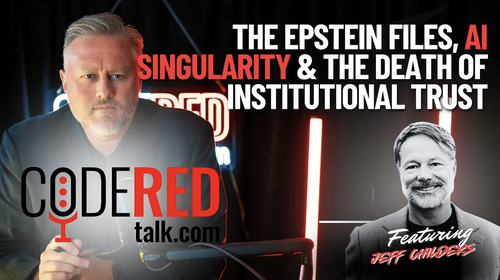
On this week’s episode of Code Red, I sat down with attorney and Coffee & Covid author Jeff Childers to unpack the two stories that tower above everything else in the news right now: the Epstein file disclosures and the AI revolution. What emerged was a conversation that went from geopolitics to local libraries, from ancient debate societies to the future of labor — and it all circles back to one haunting question: What do we do now that we know what we know?
Watch the full episode here.
On this week’s episode of Code Red, I sat down with attorney and Coffee & Covid author Jeff Childers to unpack the two stories that tower above everything else in the news right now: the Epstein file disclosures and the AI revolution. What emerged was a conversation that went from geopolitics to local libraries, from ancient debate societies to the future of labor — and it all circles back to one haunting question: What do we do now that we know what we know?
Watch the full episode here.
The Epstein Files: A Worldwide Reckoning
Put aside the noise about Minneapolis, the IRS agents, and Nancy Guthrie for a moment. The Epstein document release — all 3 million pages of it, heavily redacted — is systematically dismantling what remains of public trust in the ruling class.
And it’s not a partisan issue. This cuts across every political line.
As Jeff put it: “There’s not one of them that you would trust to babysit your kids. And you probably wouldn’t even loan them money.”
The crowdsourcing phenomenon is remarkable. Millions of ordinary citizens are combing through these documents, making connections, searching keywords, and building tools like jmail.world — a searchable interface that functions like Gmail but gives you access to Jeffrey Epstein’s email archive. The age of centralized investigation is over. The public is doing the work.
And the fallout is global. The Norwegian royal family is teetering. British Prime Minister Starmer’s government is in crisis after his appointment of Peter Mandelson — the so-called “Prince of Darkness” of British politics — as US ambassador blew up when Mandelson appeared in the Epstein documents. Starmer’s chief of staff has already resigned. The dominoes are falling.
Here in the States, mega-donors like Larry Summers have been wiped out. And we’re only in the top 1% of what these files contain.
And it’s not a partisan issue. This cuts across every political line.
As Jeff put it: “There’s not one of them that you would trust to babysit your kids. And you probably wouldn’t even loan them money.”
The crowdsourcing phenomenon is remarkable. Millions of ordinary citizens are combing through these documents, making connections, searching keywords, and building tools like jmail.world — a searchable interface that functions like Gmail but gives you access to Jeffrey Epstein’s email archive. The age of centralized investigation is over. The public is doing the work.
And the fallout is global. The Norwegian royal family is teetering. British Prime Minister Starmer’s government is in crisis after his appointment of Peter Mandelson — the so-called “Prince of Darkness” of British politics — as US ambassador blew up when Mandelson appeared in the Epstein documents. Starmer’s chief of staff has already resigned. The dominoes are falling.
Here in the States, mega-donors like Larry Summers have been wiped out. And we’re only in the top 1% of what these files contain.
The Second Ring
What’s particularly striking is what Jeff calls the “second ring” — people who aren’t in the files themselves but are connected to people who are. Starmer never met Epstein, never went to the island. But he hired someone who did. That connection alone may end his political career. The blast radius is expanding far beyond the names on the flight logs.
The Essential Death
One of the most important — and underappreciated — aspects of this story is that Epstein’s death (alleged or otherwise) was essential to everything we’re now seeing. Had he lived, his unlimited legal resources would have tied up every document for 50 years. His lawyers would have buried it all. For all legal purposes, his death unlocked the vault. His estate opened. His emails became discoverable. And here we are.
As Jeff noted, in the 2005 prosecution, Epstein’s powerful friends got him a sweetheart plea deal — a misdemeanor slap on the wrist. Trump watched it happen from Mar-a-Lago. In 2019, when Epstein was arrested again, he didn’t survive long enough for those same political favors to save him. That contrast raises uncomfortable questions — and perhaps some hopeful ones.
As Jeff noted, in the 2005 prosecution, Epstein’s powerful friends got him a sweetheart plea deal — a misdemeanor slap on the wrist. Trump watched it happen from Mar-a-Lago. In 2019, when Epstein was arrested again, he didn’t survive long enough for those same political favors to save him. That contrast raises uncomfortable questions — and perhaps some hopeful ones.
The Strategy Question
We explored a working hypothesis about the public feuds Trump orchestrates with allies — the Elon breakup, the Thomas Massie confrontation. In each case, the “enemy” goes out, makes noise, and ultimately advances Trump’s agenda. Elon said “Trump’s in the Epstein files” during their public feud. That was technically true — Trump appears as a whistleblower who cooperated with Palm Beach police. But the statement got Democrats so fired up that they voted nearly unanimously for the discharge petition ordering the DOJ to release everything.
Now Elon’s back in the White House. And the documents are out. Coincidence? Maybe. But it’s a pattern worth watching.
Now Elon’s back in the White House. And the documents are out. Coincidence? Maybe. But it’s a pattern worth watching.
The AI Singularity: When the Cost of Labor Hits Zero
The second singularity is economic. Since December, a new paradigm has emerged in artificial intelligence that is rewriting the rules.
Jeff shared a story about a small business owner — not a tech person — who asked an AI to add a button to his Excel spreadsheet. The AI responded: “Buttons don’t work well in Excel. Let me just build you an entire custom software platform.” Three hours later, the man had a fully functional, web-based business management system — built entirely by AI.
On a Spotify earnings call, the CEO told investors that senior developers haven’t written code since last year. They’re managing the AIs that write the code. A developer on the subway gets a Slack message from the AI back at the office: “This is ready for approval.” He approves the next step during his commute.
Elon Musk’s analysis is worth considering: we are approaching a moment when the cost of labor drops to near zero. Remove labor costs from goods and services, and you’re left with capital, electricity, and raw materials. Everything gets dramatically cheaper. The classic economic formula that has existed since humans started writing — labor versus capital versus productivity — is about to fundamentally change.
And that’s before we even talk about robots.
Jeff shared a story about a small business owner — not a tech person — who asked an AI to add a button to his Excel spreadsheet. The AI responded: “Buttons don’t work well in Excel. Let me just build you an entire custom software platform.” Three hours later, the man had a fully functional, web-based business management system — built entirely by AI.
On a Spotify earnings call, the CEO told investors that senior developers haven’t written code since last year. They’re managing the AIs that write the code. A developer on the subway gets a Slack message from the AI back at the office: “This is ready for approval.” He approves the next step during his commute.
Elon Musk’s analysis is worth considering: we are approaching a moment when the cost of labor drops to near zero. Remove labor costs from goods and services, and you’re left with capital, electricity, and raw materials. Everything gets dramatically cheaper. The classic economic formula that has existed since humans started writing — labor versus capital versus productivity — is about to fundamentally change.
And that’s before we even talk about robots.
The Death of the Illusion
As Christians, we shouldn’t be surprised. The doctrine of total depravity tells us that sin touches everyone — from Mother Teresa to the Pope to Billy Graham. There is no special class of people who “have it together” because they went to the right schools or sit in the right boardrooms.
But there was an illusion — a cultural assumption that the people running things were essentially decent. The Epstein files have shattered that illusion beyond repair. Jesus asked about the rich man and the eye of the needle for a reason.
The House Oversight Committee published a cropped photo of Bill Gates and former Prince Andrew from the Epstein files. But when you find the uncropped version and slide it to the right — there’s the King. I don’t know what it proves. But I believe it’s a metaphor for where this scandal is heading.
But there was an illusion — a cultural assumption that the people running things were essentially decent. The Epstein files have shattered that illusion beyond repair. Jesus asked about the rich man and the eye of the needle for a reason.
The House Oversight Committee published a cropped photo of Bill Gates and former Prince Andrew from the Epstein files. But when you find the uncropped version and slide it to the right — there’s the King. I don’t know what it proves. But I believe it’s a metaphor for where this scandal is heading.
Closer to Home: The Nassau County Library
Here’s where it gets personal. This week, local citizen Jack Knocke used AI to analyze book purchases for the Nassau County Library, searching keywords related to LGBTQ content, the pride movement, and witchcraft.
For years, the numbers were modest — a few titles here and there. Then, in the last six months to a year, the purchases skyrocketed. Hundreds of books. The line went off the chart.
I talked to a library employee. This wasn’t publishers sneaking books in. Someone had to order each title individually, by name. And there’s no policy preventing a ten-year-old from sitting down in the library and reading material of an adult nature. They can’t check it out, but they can read it right there.
It turns out a county employee hired an aggressively progressive ideologue to oversee the public library. We’ve raised the issue. So far, nothing has changed.
This is the Epstein problem in microcosm: institutional trust breaking down at every level, from the global stage to your local county.
For years, the numbers were modest — a few titles here and there. Then, in the last six months to a year, the purchases skyrocketed. Hundreds of books. The line went off the chart.
I talked to a library employee. This wasn’t publishers sneaking books in. Someone had to order each title individually, by name. And there’s no policy preventing a ten-year-old from sitting down in the library and reading material of an adult nature. They can’t check it out, but they can read it right there.
It turns out a county employee hired an aggressively progressive ideologue to oversee the public library. We’ve raised the issue. So far, nothing has changed.
This is the Epstein problem in microcosm: institutional trust breaking down at every level, from the global stage to your local county.
Resurrecting the Lyceum: A Proposal
This is where I want to float something I’ve been thinking about for a while.
I’ve been reading about the Lyceum movement — the debating societies that flourished across America in the 1800s and produced the Lincoln-Douglas debates. North, south, small towns, big cities. Men would gather, younger men in their twenties would be assigned topics, coached by experienced mentors, and debate the issues before their community. There were rules. There was decorum. No heckling. And at the end, the audience responded — who won, how could they improve, who might be ready to run for office.
Think of it like a UFC fight card for civic engagement. The undercard features younger, less experienced debaters building their muscles. The main event brings in the heavyweights — experienced leaders, political candidates, community figures.
The topics wouldn’t be theoretical. They’d be local. Paid parking in Fernandina Beach. Library book purchasing policies. Who should be the next governor of Florida — and why.
I’ve been bouncing this idea off people from across the political spectrum. The response has been overwhelmingly positive. One local venue was eager to host. This could be ticketed, live-streamed, and scaled across the state.
The most important thing about classical debate isn’t that it teaches people how to argue. It teaches them how to think. If our kids understood classical logical fallacies — like the Appeal to Authority (”Well, the CDC says...”) — they would be far less susceptible to propaganda.
Jeff and I both turned 50 recently. We’re just now learning how local government actually works. That’s a failure of civics education that we cannot pass on to the next generation.
The alternative to rebuilding trust in institutions is anarchy. And nobody wants that. But rebuilding is going to require more than polish. It’s going to require citizens getting in a room, having honest conversations, and doing it pro bono — because this isn’t a business model. It’s a civic duty.
I’ve been reading about the Lyceum movement — the debating societies that flourished across America in the 1800s and produced the Lincoln-Douglas debates. North, south, small towns, big cities. Men would gather, younger men in their twenties would be assigned topics, coached by experienced mentors, and debate the issues before their community. There were rules. There was decorum. No heckling. And at the end, the audience responded — who won, how could they improve, who might be ready to run for office.
Think of it like a UFC fight card for civic engagement. The undercard features younger, less experienced debaters building their muscles. The main event brings in the heavyweights — experienced leaders, political candidates, community figures.
The topics wouldn’t be theoretical. They’d be local. Paid parking in Fernandina Beach. Library book purchasing policies. Who should be the next governor of Florida — and why.
I’ve been bouncing this idea off people from across the political spectrum. The response has been overwhelmingly positive. One local venue was eager to host. This could be ticketed, live-streamed, and scaled across the state.
The most important thing about classical debate isn’t that it teaches people how to argue. It teaches them how to think. If our kids understood classical logical fallacies — like the Appeal to Authority (”Well, the CDC says...”) — they would be far less susceptible to propaganda.
Jeff and I both turned 50 recently. We’re just now learning how local government actually works. That’s a failure of civics education that we cannot pass on to the next generation.
The alternative to rebuilding trust in institutions is anarchy. And nobody wants that. But rebuilding is going to require more than polish. It’s going to require citizens getting in a room, having honest conversations, and doing it pro bono — because this isn’t a business model. It’s a civic duty.
Final Thought
We are watching two singularities collide: the political collapse of institutional credibility and the economic revolution of artificial intelligence. Neither has a precedent in human history. Both demand that ordinary citizens step up, pay attention, and get involved — starting in their own communities.
The king has no clothes. And it’s time we stopped pretending otherwise.
Watch the full episode: Code Red with Jeff Childers
Subscribe to Jeff Childers’ newsletter: Coffee & Covid on Substack
Subscribe to my Substack: Zach Terry on Substack
Learn more about Code Red: coderedtalk.com
Download the Maximum Life+ App: Available on the App Store and Google Play Store
The king has no clothes. And it’s time we stopped pretending otherwise.
Watch the full episode: Code Red with Jeff Childers
Subscribe to Jeff Childers’ newsletter: Coffee & Covid on Substack
Subscribe to my Substack: Zach Terry on Substack
Learn more about Code Red: coderedtalk.com
Download the Maximum Life+ App: Available on the App Store and Google Play Store
The Maximum Life Blog
My name is Zach Terry. The thoughts and opinions expressed in this blog are my own, with occasional interjections from my bride of nearly 25 years, Julie. This format of publication is meant to allow for engagement and interaction. Feel free to comment. But please, be nice.
Recent
Archive
2026
January
Cleansing the PalateThe Library of MankindSuch a Strange Way to Save the WorldLoved Like RachelCode Red | From the Army to Audiobooks — Faith, Literature, and the Making of a Voice ActorConverts and ConflictMaids and Mandrakes: Dysfunction, Departure, and Divine Grace in Genesis 30The Importance of Children's Theology BooksDealing with a Narcissist
2025
February
March
July
August
September
October
Why We Should Bless IsraelGovernment Shutdowns and God’s Blueprint for Smaller GovernmentCompassion and ConsequencesSodom, Netflix, and the Two Paths Before UsRevival Isn’t a Rumor — It’s HappeningIt’s Time to Stop Playing It SafeA New Door OpensPreach the Word. Show Your Hand.When “Love Your Neighbor” Becomes a WeaponA New Day DawningPaving the Way of Anti-ChristThe Church and the Honky-TonkMy Personal Position on Israel
November
2024
April
May
No Comments