The Martyrdom of Stephen
How One Man’s Faith Shaped the Apostle Paul and Echoes Through History
Second only to scripture, my life has been shaped by the time I have spent reading biographies. Dr. Elton Trueblood was a Quaker theologian who served as chaplain at both Harvard and Stanford universities. He stated that every young man needs a compelling vision of manhood to follow throughout his life. Dr. Mohler added that he needs one larger-than-life historical figure and a compelling vision of manhood that he can see up close. As we study the lives of significant historical figures, we change, becoming the footnotes and commentaries that our sons and daughters read and are shaped by. For this reason, I like to study the great characters of scripture from time to time.
In a recent post, we looked at the three streams that came together to form the river of Paul’s life. We said that “Paul’s Greek world shaped his mind. Paul’s Roman world shaped his mission. Paul’s Jewish world shaped his soul.”
Pastor Ed Donnelly also reminded us, “The study of a great man is much like the study of a great mountain, which ever side you stand on lends you a certain perspective, but you are limited to the other potential perspectives.” However, when it comes to the life of Paul the Apostle, we are given a wealth of information about this man’s life from the vantage point of the heavenly perspective. Therefore, we can be sure that our vantage point is accurate because it is God's appraisal.
Context
To understand Paul, we must understand the context into which he was thrust. The Early Church’s beginning, in many ways, parallels the launching of Christ’s earthly ministry—in that it began with much favor and widespread approval, but, over time, public opinion turned.
Peter and John were arrested in Acts 4 but responded with great boldness, and the church continued to grow and prosper in its popularity.
Not a bad time to be connected to Christianity. But there was a problem—it seems at this point the Church was beginning to drift toward syncretism.
This was partly to remain at least loosely connected to the Jewish community for the sake of Evangelism, and partly because the implications of this new teaching had not yet been fully realized. Perhaps Christianity was to be understood as a branch of Judaism, a sect within the larger Jewish community. Or perhaps it was something totally different.
Enter Stephen
That all changed as a young man named Stephen began to teach.
Deacon - Stephen was one of the first deacons selected to serve the Jerusalem Church. But his being a deacon did not stop him from being an incredible evangelist.
Now, understand: Peter was the primary spokesman for the Apostles. He preached the sermon on the Day of Pentecost. Peter spoke for the disciples when Jesus asked, “Who do men say that I am?” But throughout history, God has typically raised leaders in twos: Moses had an Aaron, Paul had a Timothy
Martin Luther reclaimed the doctrine of justification by faith alone, but he did not fully develop its implications for worship within the greater church. While Luther was a great preacher of the Gospel, Philip Melanchthon had the mind to develop theology and explain all of its implications.
This same comparison can be made between Simon Peter and Stephen. Peter was the great herald of the truth, but Stephen recognized how the Gospel affected their lives as they knew them.
The unique aspect of Stephen’s preaching was that he recognized that if everything we believed about Christ were true, then temple worship would be obsolete.
You see, JESUS was everything the Temple had been pointing to.
Apparently, Stephen had preached to the Jewish people that they no longer needed the shadow; the substance had arrived! TEMPLE WORSHIP WAS OBSOLETE.
THAT’S WHAT STEPHEN WAS SAYING - JESUS IS MUCH BETTER THAN THE TEMPLE.
His preaching carried the same logical appeal that “they were unable to cope with the Spirit with which he was speaking” (Acts 6:12). As a result, he was brought before the Sanhedrin, a Jewish legal body.
Sermon
Stephen begins an incredible sermon as he highlights how God has always been bigger than one place:
What was the conclusion? God was not limited to a single place, and we did not have to be limited to worship in the Temple. In quoting Isaiah, Stephen said,
Then he began to indict the crowd, putting them on trial before God for their unbelief.
They responded with incredible anger—
57 But they cried out with a loud voice and stopped their ears and rushed together at him. 58 Then they cast him out of the city and stoned him. And the witnesses laid down their garments at the feet of a young man named Saul.
In a recent post, we looked at the three streams that came together to form the river of Paul’s life. We said that “Paul’s Greek world shaped his mind. Paul’s Roman world shaped his mission. Paul’s Jewish world shaped his soul.”
Pastor Ed Donnelly also reminded us, “The study of a great man is much like the study of a great mountain, which ever side you stand on lends you a certain perspective, but you are limited to the other potential perspectives.” However, when it comes to the life of Paul the Apostle, we are given a wealth of information about this man’s life from the vantage point of the heavenly perspective. Therefore, we can be sure that our vantage point is accurate because it is God's appraisal.
Context
To understand Paul, we must understand the context into which he was thrust. The Early Church’s beginning, in many ways, parallels the launching of Christ’s earthly ministry—in that it began with much favor and widespread approval, but, over time, public opinion turned.
- The coming of the Holy Spirit on the day of Pentecost gave the Jerusalem Church, some 120 strong, an incredible boost, adding 3000 new members. It was an overnight mega-church. One of the key doctrines of this new movement was the resurrection of Christ. This teaching set them at odds with the Sadducees (who believed in no resurrection).
Peter and John were arrested in Acts 4 but responded with great boldness, and the church continued to grow and prosper in its popularity.
- Acts 2:47 tells us they were praising God and having favor with all the people. And the Lord was adding to their number day by day those who were being saved.
- In Acts 4:33, it tells us that... abundant grace was upon them all.
- Acts 4:4 reports that the Church had grown to 5000. But many of those who had heard the message believed, and the number of the men came to be about five thousand.
- Acts 5:13 tells us that, “the people held them in high esteem. And all the more believers in the Lord, multitudes of men and women, were constantly added to their number.”
- By Acts 6:7, the word of God kept on spreading, and the number of the disciples continued to increase greatly in Jerusalem, and a great many of the priests were becoming obedient to the faith.
Not a bad time to be connected to Christianity. But there was a problem—it seems at this point the Church was beginning to drift toward syncretism.
- Many believers were still taking part in temple worship.
- The Church leaders still submitted to the synagogues’ discipline. (Later in Acts we see that Paul received 39 lashes)
This was partly to remain at least loosely connected to the Jewish community for the sake of Evangelism, and partly because the implications of this new teaching had not yet been fully realized. Perhaps Christianity was to be understood as a branch of Judaism, a sect within the larger Jewish community. Or perhaps it was something totally different.
Enter Stephen
That all changed as a young man named Stephen began to teach.
Deacon - Stephen was one of the first deacons selected to serve the Jerusalem Church. But his being a deacon did not stop him from being an incredible evangelist.
Now, understand: Peter was the primary spokesman for the Apostles. He preached the sermon on the Day of Pentecost. Peter spoke for the disciples when Jesus asked, “Who do men say that I am?” But throughout history, God has typically raised leaders in twos: Moses had an Aaron, Paul had a Timothy
Martin Luther reclaimed the doctrine of justification by faith alone, but he did not fully develop its implications for worship within the greater church. While Luther was a great preacher of the Gospel, Philip Melanchthon had the mind to develop theology and explain all of its implications.
This same comparison can be made between Simon Peter and Stephen. Peter was the great herald of the truth, but Stephen recognized how the Gospel affected their lives as they knew them.
The unique aspect of Stephen’s preaching was that he recognized that if everything we believed about Christ were true, then temple worship would be obsolete.
You see, JESUS was everything the Temple had been pointing to.
- Incarnation - The Jewish temple was the earthly embodiment of God’s revelation to humanity. It was there that the Shekinah glory dwelt. It was the closest thing to an incarnation the Jews had ever seen, until Jesus.
- Atonement - The temple was a place of sacrifice and atonement for sins, until Christ, when his blood paid the ultimate price for man’s sin.
- Mediation - The temple was the place where an earthly priest went before God on our behalf, begging a pardon for our sins—until Christ, who is the GREAT HIGH PRIEST, entered the Holy of Holies and sprinkled his own blood on the mercy seat, silencing the demands of the law, crying out against us.
Apparently, Stephen had preached to the Jewish people that they no longer needed the shadow; the substance had arrived! TEMPLE WORSHIP WAS OBSOLETE.
THAT’S WHAT STEPHEN WAS SAYING - JESUS IS MUCH BETTER THAN THE TEMPLE.
His preaching carried the same logical appeal that “they were unable to cope with the Spirit with which he was speaking” (Acts 6:12). As a result, he was brought before the Sanhedrin, a Jewish legal body.
Acts 6:13–14 (ESV) 13 and they set up false witnesses who said, “This man never ceases to speak words against this holy place and the law, 14 for we have heard him say that this Jesus of Nazareth will destroy this place and will change the customs that Moses delivered to us.”
Sermon
Stephen begins an incredible sermon as he highlights how God has always been bigger than one place:
- God was with Abraham in Mesopotamia - Acts 7:2
- God was with the Fathers in Egypt - Acts 7:6
- God was with Moses in the wilderness - Acts 7:19
- God was with Joshua as he came into the land of promise - Acts 7:45
- God was with David and Solomon as they built the Temple - Acts 7:46
What was the conclusion? God was not limited to a single place, and we did not have to be limited to worship in the Temple. In quoting Isaiah, Stephen said,
48 “However, the Most High does not dwell in houses made by human hands; as the prophet says: 49 ‘Heaven is My throne, And earth is the footstool of My feet; What kind of house will you build for Me?’ says the Lord, ‘Or what place is there for My repose? 50 ‘Was it not My hand which made all these things?’
Then he began to indict the crowd, putting them on trial before God for their unbelief.
Acts 7:51–53 (ESV) 51 “You stiff-necked people, uncircumcised in heart and ears, you always resist the Holy Spirit. As your fathers did, so do you. 52 Which of the prophets did your fathers not persecute? And they killed those who announced beforehand the coming of the Righteous One, whom you have now betrayed and murdered, 53 you who received the law as delivered by angels and did not keep it.”
They responded with incredible anger—
Acts 7:54–58 (ESV) 54 Now when they heard these things they were enraged, and they ground their teeth at him. 55 But he, full of the Holy Spirit, gazed into heaven and saw the glory of God, and Jesus standing at the right hand of God. 56 And he said, “Behold, I see the heavens opened, and the Son of Man standing at the right hand of God.”
57 But they cried out with a loud voice and stopped their ears and rushed together at him. 58 Then they cast him out of the city and stoned him. And the witnesses laid down their garments at the feet of a young man named Saul.
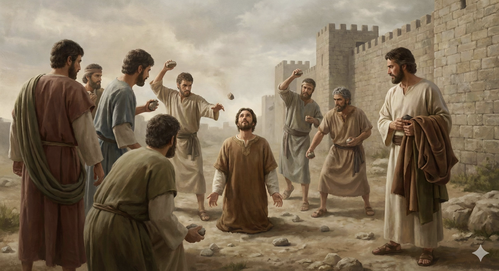
There is our great Apostle... before his conversion, witnessing Stephen’s stoning.
Theologians tell us that the fact that the people laid their garments at Saul’s feet is significant in that it leads us to think that Saul may have instigated the martyrdom of Stephen.
We see this is in keeping with what we know of Saul’s persecution of the Church. According to Acts 8:3, “But Saul began ravaging the church...”
One can’t help but wonder what went through the mind of Saul as he heard the words of Stephen—
I am sharing this story because this experience was second only to the Damascus road in making an impression on young Saul of Tarsus. This was the first time that we know Saul clearly heard and saw the Gospel. He heard it in Stephen’s defense, and he saw it in Stephen’s calling for their forgiveness in the midst of his death.
You see, the goal of Stephen’s life was to see men and women made right with God—He didn’t want any sin against him to stand in the way of his life’s mission. BTW, can you do that? Are you so driven by the Gospel, so passionate about seeing others brought to peace with Christ, that you REFUSE to allow personal offenses to stand in the way of that goal?
SAUL’S Response? He Acts 8:1 (NASB95)
Later in his life, Paul would declare himself the CHIEF SINNER, and because of this story, he was right.
You see, this was the first Christian to die for his faith, and there have been BILLIONS since.
Data on Modern Persecution
The gold standard for tracking this nightmare is Open Doors’ World Watch List 2025, audited by the International Institute for Religious Freedom and based on boots-on-the-ground intel from October 1, 2023, to September 30, 2024. Their verdict? 4,476 Christians were killed for their faith last year. That’s more than 12 a day—one every two hours. Not in some ancient persecution, but right now, in 2025.1
Saul of Tarsus opened that door—do you see why he considered himself the chief of sinners? He quite possibly was the primary agent in opening the door to the death of Billions of the Lord’s people.
But let me tell you—you can’t read of Christian martyrs and you surely can’t witness a Christian dying for his or her faith without it RADICALLY affecting you. It is interesting to consider that just a few years later, Saul would return to this same city as one who worshipped the same Jesus whom Stephen preached. Saul would one day look Stephen’s widow in the eye. He would one day preach to Stephen’s orphaned children.
Behold what grace was bestowed as God answered Stephen’s final prayer—“do not hold this sin against them!”
If Stephen Were Here Today
If Stephen were here today, what might he preach? Revelation from God holds Redirection for Man.
When Nicholas Copernicus published his model of heliocentrism in 1543, it turned the world upside down. The popular geo-centric model was now obsolete. But the theory in itself, while revolutionary, was not as important as the implications it held. Heliocentrism held implications for:
In one declaration, he turned the world as we knew it upside down.
Theologians tell us that the fact that the people laid their garments at Saul’s feet is significant in that it leads us to think that Saul may have instigated the martyrdom of Stephen.
We see this is in keeping with what we know of Saul’s persecution of the Church. According to Acts 8:3, “But Saul began ravaging the church...”
One can’t help but wonder what went through the mind of Saul as he heard the words of Stephen—
59 They went on stoning Stephen as he called on the Lord and said, “Lord Jesus, receive my spirit!” 60 Then falling on his knees, he cried out with a loud voice, “Lord, do not hold this sin against them!” Having said this, he fell asleep.
I am sharing this story because this experience was second only to the Damascus road in making an impression on young Saul of Tarsus. This was the first time that we know Saul clearly heard and saw the Gospel. He heard it in Stephen’s defense, and he saw it in Stephen’s calling for their forgiveness in the midst of his death.
You see, the goal of Stephen’s life was to see men and women made right with God—He didn’t want any sin against him to stand in the way of his life’s mission. BTW, can you do that? Are you so driven by the Gospel, so passionate about seeing others brought to peace with Christ, that you REFUSE to allow personal offenses to stand in the way of that goal?
SAUL’S Response? He Acts 8:1 (NASB95)
1 Saul was in hearty agreement with putting him to death. And on that day a great persecution began against the church in Jerusalem, and they were all scattered throughout the regions of Judea and Samaria, except the apostles.
Later in his life, Paul would declare himself the CHIEF SINNER, and because of this story, he was right.
You see, this was the first Christian to die for his faith, and there have been BILLIONS since.
Data on Modern Persecution
The gold standard for tracking this nightmare is Open Doors’ World Watch List 2025, audited by the International Institute for Religious Freedom and based on boots-on-the-ground intel from October 1, 2023, to September 30, 2024. Their verdict? 4,476 Christians were killed for their faith last year. That’s more than 12 a day—one every two hours. Not in some ancient persecution, but right now, in 2025.1
Saul of Tarsus opened that door—do you see why he considered himself the chief of sinners? He quite possibly was the primary agent in opening the door to the death of Billions of the Lord’s people.
But let me tell you—you can’t read of Christian martyrs and you surely can’t witness a Christian dying for his or her faith without it RADICALLY affecting you. It is interesting to consider that just a few years later, Saul would return to this same city as one who worshipped the same Jesus whom Stephen preached. Saul would one day look Stephen’s widow in the eye. He would one day preach to Stephen’s orphaned children.
Behold what grace was bestowed as God answered Stephen’s final prayer—“do not hold this sin against them!”
If Stephen Were Here Today
If Stephen were here today, what might he preach? Revelation from God holds Redirection for Man.
When Nicholas Copernicus published his model of heliocentrism in 1543, it turned the world upside down. The popular geo-centric model was now obsolete. But the theory in itself, while revolutionary, was not as important as the implications it held. Heliocentrism held implications for:
- Gravity
- The Calendar
- The orbit of the planets
- The axis of the Earth
In one declaration, he turned the world as we knew it upside down.
The Maximum Life Blog
My name is Zach Terry. The thoughts and opinions expressed in this blog are my own, with occasional interjections from my bride of nearly 25 years, Julie. This format of publication is meant to allow for engagement and interaction. Feel free to comment. But please, be nice.
Recent
Archive
2026
January
Converts and ConflictCode Red | From the Army to Audiobooks — Faith, Literature, and the Making of a Voice ActorLoved Like RachelSuch a Strange Way to Save the WorldThe Library of MankindCleansing the PalateMaids and Mandrakes: Dysfunction, Departure, and Divine Grace in Genesis 30Dealing with a NarcissistThe Importance of Children's Theology Books
February
2025
February
March
July
August
September
October
Why We Should Bless IsraelGovernment Shutdowns and God’s Blueprint for Smaller GovernmentCompassion and ConsequencesSodom, Netflix, and the Two Paths Before UsRevival Isn’t a Rumor — It’s HappeningIt’s Time to Stop Playing It SafeA New Door OpensPreach the Word. Show Your Hand.When “Love Your Neighbor” Becomes a WeaponA New Day DawningPaving the Way of Anti-ChristThe Church and the Honky-TonkMy Personal Position on Israel
November
2024
April
May
August
November
No Comments