Code Red | From the Army to Audiobooks — Faith, Literature, and the Making of a Voice Actor
A conversation with Jake Phillips
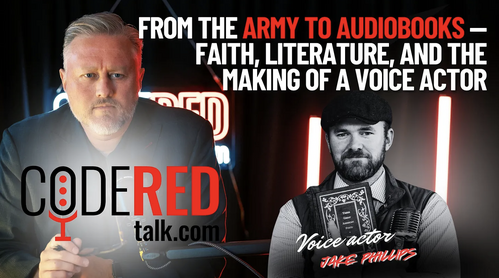
Jake Phillips and the Long Road to a Well-Trained Voice
Some lives make sense only when you listen carefully.
Jake Phillips is one of those men whose story unfolds slowly—like a good book, not a headline. You don’t understand him by skimming. You understand him by lingering.
Born and raised outside Starkville, Mississippi—deep in SEC country, red dirt, and thick humidity—Jake grew up in a home where words mattered. His parents didn’t merely educate their children; they formed them. Two daily read-aloud sessions were standard. Laura Ingalls Wilder by day. Pilgrim’s Progress and Ben-Hur by night. Scripture always.
Jake Phillips is one of those men whose story unfolds slowly—like a good book, not a headline. You don’t understand him by skimming. You understand him by lingering.
Born and raised outside Starkville, Mississippi—deep in SEC country, red dirt, and thick humidity—Jake grew up in a home where words mattered. His parents didn’t merely educate their children; they formed them. Two daily read-aloud sessions were standard. Laura Ingalls Wilder by day. Pilgrim’s Progress and Ben-Hur by night. Scripture always.
This was not nostalgia. It was preparation.
A Faith Formed Before It Was Chosen
Jake came to faith early, but like many young believers, there was a difference between inherited conviction and owned conviction. By sixteen, Scripture was no longer something read because “Dad thought I should.” It had become daily bread.
That pattern never left him.
Years later—standing in the California desert at Fort Irwin, training for deployment to Iraq—Jake would still open his Bible every day. But there, amid heat, dust, and anticipation of war, a fellow soldier handed him an unlikely companion: Pride and Prejudice.
It was not a military book.
And yet, it was.
Jane Austen’s world—ordered, moral, structured toward marriage, responsibility, and consequence—felt oddly familiar. Wickham’s duplicity was not celebrated. He was exposed. Courtship was serious. Honor mattered.
Jake recognized something many modern readers miss: when a culture is shaped by Scripture, even its fiction carries moral weight.
That pattern never left him.
Years later—standing in the California desert at Fort Irwin, training for deployment to Iraq—Jake would still open his Bible every day. But there, amid heat, dust, and anticipation of war, a fellow soldier handed him an unlikely companion: Pride and Prejudice.
It was not a military book.
And yet, it was.
Jane Austen’s world—ordered, moral, structured toward marriage, responsibility, and consequence—felt oddly familiar. Wickham’s duplicity was not celebrated. He was exposed. Courtship was serious. Honor mattered.
Jake recognized something many modern readers miss: when a culture is shaped by Scripture, even its fiction carries moral weight.
September 11 and the Call to Serve
Like many of his generation, Jake remembers life before and after September 11, 2001.
That day did not immediately feel catastrophic. He had read history. Accidents happened. But by evening, clarity arrived. He told his father he would join the Army.
This decision didn’t emerge from recklessness. It grew out of a childhood shaped by gratitude—especially toward veterans. If Jake’s father saw a World War II veteran wearing a cap, the boys were taught to stop, look him in the eye, shake his hand, and say thank you.
Heroes were not abstract. They were flesh and blood.
That day did not immediately feel catastrophic. He had read history. Accidents happened. But by evening, clarity arrived. He told his father he would join the Army.
This decision didn’t emerge from recklessness. It grew out of a childhood shaped by gratitude—especially toward veterans. If Jake’s father saw a World War II veteran wearing a cap, the boys were taught to stop, look him in the eye, shake his hand, and say thank you.
Heroes were not abstract. They were flesh and blood.
Learning to Be Heard
Jake entered the Army with a strong Southern accent—and discovered quickly that accents can be liabilities.
A platoon sergeant pulled him aside one day and said, bluntly:
“Sir, nobody can understand you. You’re going to get us killed if you talk like that on the radio.”
It stung. But it also awakened something.
Jake realized—perhaps for the first time—that speech is not fixed. It can be trained. Refined. Disciplined. Clear communication is not cosmetic; it is moral. Scripture itself warns that an uncertain trumpet sound in battle leads to disaster.
So Jake listened. He studied. He learned Midwestern diction. He learned to enunciate. He learned to choose his voice.
Without knowing it, he had taken the first step toward becoming a voice actor.
A platoon sergeant pulled him aside one day and said, bluntly:
“Sir, nobody can understand you. You’re going to get us killed if you talk like that on the radio.”
It stung. But it also awakened something.
Jake realized—perhaps for the first time—that speech is not fixed. It can be trained. Refined. Disciplined. Clear communication is not cosmetic; it is moral. Scripture itself warns that an uncertain trumpet sound in battle leads to disaster.
So Jake listened. He studied. He learned Midwestern diction. He learned to enunciate. He learned to choose his voice.
Without knowing it, he had taken the first step toward becoming a voice actor.
Loss, Memory, and the Power of a Recorded Voice
In 2013, Jake’s father died of cancer—just weeks before meeting his granddaughter.
What remained was a single recording: his father’s voice reading Scripture in a short film about David and Goliath. That recording became a treasure.
And it sparked a question.
Why should voices disappear?
Jake had spent years listening to audiobooks—especially The Chronicles of Narnia, performed by world-class narrators. He knew the difference between reading words and inhabiting them. A great narrator doesn’t perform drunkenness; he performs the attempt to appear sober. He doesn’t recite; he thinks aloud.
So Jake bought a microphone. Then another. He recorded in closets. He learned editing on YouTube. He read texts no one asked him to read.
And slowly, people started asking.
“What would you charge to read this?”
What remained was a single recording: his father’s voice reading Scripture in a short film about David and Goliath. That recording became a treasure.
And it sparked a question.
Why should voices disappear?
Jake had spent years listening to audiobooks—especially The Chronicles of Narnia, performed by world-class narrators. He knew the difference between reading words and inhabiting them. A great narrator doesn’t perform drunkenness; he performs the attempt to appear sober. He doesn’t recite; he thinks aloud.
So Jake bought a microphone. Then another. He recorded in closets. He learned editing on YouTube. He read texts no one asked him to read.
And slowly, people started asking.
“What would you charge to read this?”
From Closet to Calling
The first paid job paid a hundred dollars. It felt like a miracle.
Jake realized something profound: the market was not paying him to fake something. It was rewarding him for a gift that had been quietly shaped for decades—through Scripture, classical literature, military discipline, loss, and attention.
He leaned in fully.
Community theater followed—not for fame, but for reps. Voice acting, after all, is acting. And acting is truth under pressure.
But Jake also drew lines.
He would not kiss another woman on stage. He would not glory in sin. He would portray brokenness honestly, but never celebrate it dishonestly.
Like Daniel in Babylon, he decided beforehand what he would not do.
Jake realized something profound: the market was not paying him to fake something. It was rewarding him for a gift that had been quietly shaped for decades—through Scripture, classical literature, military discipline, loss, and attention.
He leaned in fully.
Community theater followed—not for fame, but for reps. Voice acting, after all, is acting. And acting is truth under pressure.
But Jake also drew lines.
He would not kiss another woman on stage. He would not glory in sin. He would portray brokenness honestly, but never celebrate it dishonestly.
Like Daniel in Babylon, he decided beforehand what he would not do.
The Cultured Bumpkin
In 2018, Jake embraced the name that finally fit: The Cultured Bumpkin.
A Southerner who loves the classics.
A Christian who believes beauty disciplines the soul.
An introvert whose voice reaches thousands.
Ironically, most of Jake’s paid work uses no accent at all. Clients want clarity. Neutrality. Trust. But the Southern voice remains part of who he is—something he can dial in or out, like a well-tuned instrument.
In an age of AI voices and synthetic narration, Jake has learned this: people don’t just want sound. They want presence. Interpretation. Humanity.
They want a voice that has lived.
A Southerner who loves the classics.
A Christian who believes beauty disciplines the soul.
An introvert whose voice reaches thousands.
Ironically, most of Jake’s paid work uses no accent at all. Clients want clarity. Neutrality. Trust. But the Southern voice remains part of who he is—something he can dial in or out, like a well-tuned instrument.
In an age of AI voices and synthetic narration, Jake has learned this: people don’t just want sound. They want presence. Interpretation. Humanity.
They want a voice that has lived.
Why His Story Matters
Jake Phillips is not famous.
He is not loud.
He did not chase relevance.
He paid attention.
He honored tradition.
He disciplined his craft.
He walked faithfully through obscurity.
And now—whether reading Scripture, narrating literature, or lending his voice to stories that matter—he reminds us of something we are in danger of forgetting:
Words shape worlds.
Voices carry values.
And formation always precedes vocation.
He is not loud.
He did not chase relevance.
He paid attention.
He honored tradition.
He disciplined his craft.
He walked faithfully through obscurity.
And now—whether reading Scripture, narrating literature, or lending his voice to stories that matter—he reminds us of something we are in danger of forgetting:
Words shape worlds.
Voices carry values.
And formation always precedes vocation.
The Maximum Life Blog
My name is Zach Terry. The thoughts and opinions expressed in this blog are my own, with occasional interjections from my bride of nearly 25 years, Julie. This format of publication is meant to allow for engagement and interaction. Feel free to comment. But please, be nice.
Recent
Archive
2026
January
Cleansing the PalateThe Library of MankindSuch a Strange Way to Save the WorldLoved Like RachelCode Red | From the Army to Audiobooks — Faith, Literature, and the Making of a Voice ActorConverts and ConflictMaids and Mandrakes: Dysfunction, Departure, and Divine Grace in Genesis 30The Importance of Children's Theology BooksDealing with a Narcissist
2025
February
March
July
August
September
October
Why We Should Bless IsraelGovernment Shutdowns and God’s Blueprint for Smaller GovernmentCompassion and ConsequencesSodom, Netflix, and the Two Paths Before UsRevival Isn’t a Rumor — It’s HappeningIt’s Time to Stop Playing It SafeA New Door OpensPreach the Word. Show Your Hand.When “Love Your Neighbor” Becomes a WeaponA New Day DawningPaving the Way of Anti-ChristThe Church and the Honky-TonkMy Personal Position on Israel
November
2024
April
May
August
No Comments